
Welcome to the May CT HCC Newsletter, a one-stop shop for activities of the Connecticut Health Care Coalition (CT HCC) and its partners.
What is in this volume:
RECAP: 2026 Connecticut Health Care Coalition Conference
The Coalition-Sponsored Evacuation Summit
Approved Special Projects FY 25-26
2026 FIFA World Cup Emergency Preparedness Resources Page
emPOWER Emergency Planning De-identified Datasets (March 2026)
Application of the National Incident Management System Course
Pediatric Pandemic Network Update
Medical Countermeasures Course
ASPR RISC 2.0 Toolkit
Sign Up for a Meet and Greet
Additional trainings can be found on the Training and Exercise page of this website:
RECAP: 2026 CTHCC Annual Conference
The annual Connecticut Health Care Coalition (CT HCC) Conference was held this past Tuesday, April 28, 2026. Various stakeholders in healthcare emergency management from across the state participated in a day of learning and exercise related to this year's core theme of strengthening communication in preparedness and times of crisis.
In our efforts to continue to provide quality events and learning opportunities to our coalition, we've asked all attendees to complete a conference evaluation form. If you attended the conference and have not yet had a chance to complete the evaluation form, please do so here.
For a full review of conference speakers, session titles, and associated materials, please visit the 2026 CT HCC Conference page.
Coalition-Sponsored Evacuation Summit on May 5
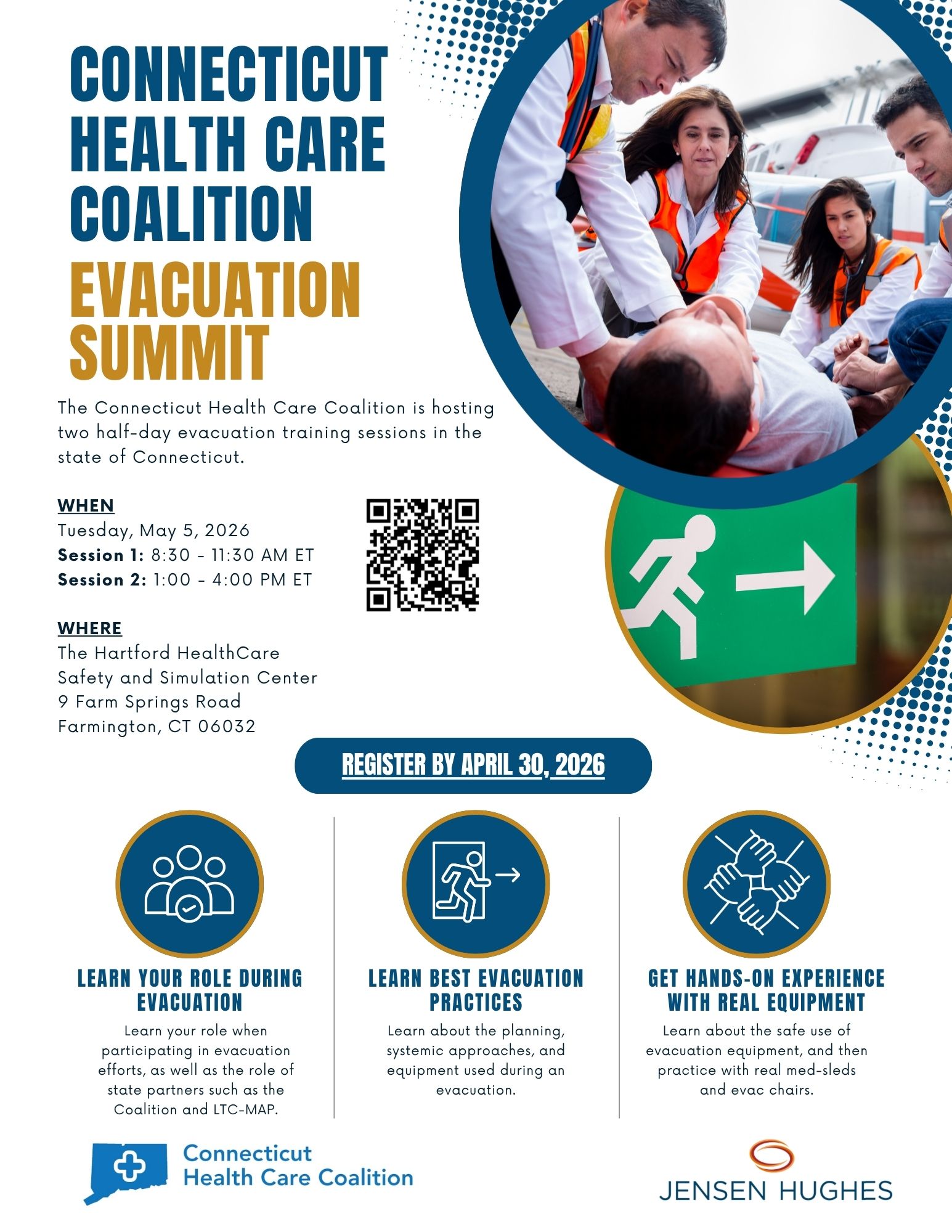
Click here to download the PDF version of this flyer
The CT HCC is sponsoring an evacuation summit to take place on May 5, 2026. Get hands-on training with real evacuation equipment and learn evacuation best practices. Each session has 30 seats, so register today while there are still some available!
Approved Special Projects FY 25-26

The CT HCC Executive Committee recently approved eight special projects for the 2025-2026 fiscal year. These projects will support healthcare emergency preparedness efforts across the state, serving a wide range of coalition needs. The approved projects have been listed below:
- Supplies to Support EMS Capabilities
- Supplies to Support Active Assailant Program For Mass Casualty
- CR-MRC Training Academy
- Statewide MRC Assessment
- Dahlgren Decontamination Project
- Portable Sink Purchase
- Evacuation Summit
- CT HCC Website Redesign
For specific project descriptions and costs, please see the Special Projects Summary Flyer.
2026 FIFA World Cup Preparedness Resources Page

The Connecticut Department of Public Health in collaboration with CT HCC has sponsored a small workgroup focused on healthcare emergency preparedness efforts in Connecticut in preparation for the 2026 FIFA World Cup, happening during the months of June and July. While no official matches or events will take place in the state of Connecticut, there will be matches held at both Gillette Stadium in Foxborough, Massachusetts, and MetLife Stadium in East Rutherford, New Jersey (adjacent to New York City).
Given the proximity of these locations to the state of Connecticut, the workgroup has been gathering resources to stay informed about healthcare preparedness efforts related to the FIFA World Cup in both Connecticut and neighboring states. For anyone that is interested in learning more about these efforts or staying informed throughout the event, CT HCC has compiled a list of these resources and created a 2026 FIFA World Cup Emergency Preparedness Resources Page on this website.
emPOWER Emergency Planning De-identified Datasets (March 2026)
The de-identified (HIPAA masked) dataset includes at-risk Medicare beneficiaries from the Medicare Fee-For-Service (FFS/Parts A & B) and Medicare Advantage (CMS’ HMO plans/Part C) Programs that rely upon the electricity-dependent durable medical equipment (DME) and cardiac implantable devices and healthcare services that include ESRD (dialysis), oxygen tank services, and home health visits. Detailed information regarding the dataset is included in the Menu tab and the Data Overview tabs of the attached workbook.
State Zip Aggregation: We weren't able to identify geospatial boundary data for a number of the zip codes in the state. Due to this we have had to aggregate the data for those zip codes (child zip code) with another zip code that it resides in or next to (parent zip code) to ensure we didn’t lose population data associated with those zip codes. The third tab in the dataset provides the mapping for zip codes that meet this criteria.
Purpose: ASPR, in partnership with CMS, are providing limited de-identified Medicare data to State and local health departments to enhance situational awareness of and support emergency planning for and public health response activities for at-risk individuals that rely upon select electricity-dependent durable medical equipment (DME), facility-based dialysis and oxygen tank services prior to, during, or after an emergency or disaster. The DME that are included are: ventilators, oxygen concentrators, IV infusion pumps, suction pumps, at-home dialysis, electric wheelchairs and electric beds.
Data Source: The CMS dataset is developed from Medicare Fee For Service (FFS) Part A and B beneficiary administrative claims data (~32M 65+, blind, ESRD (dialysis), dual-eligible, disabled-can include adults and children) and Medicare Advantage claims data (~17M 65+, blind, ESRD (dialysis), dual-eligible, disabled-can include adults and children). This data does not include individuals that are only enrolled in a State Medicaid Program. It is important to note that Medicare DME are subject to insurance claim reimbursement caps (e.g. rental caps) that differ by type and therefore may have a different “look-back” periods (e.g. ventilators are 13 months and oxygen concentrators are 36 months) all of which are provided in the Menu and Data Overview tabs of the workbook.
Approved Data Uses: The de-identified dataset is approved for use by the state and local health department, either directly or in collaboration with their ESF-8, 6, 14 or other partners as appropriate, for public health emergency response, preparedness/mitigation, recovery and resilience activities. All other potential uses of this data require prior approval from ASPR and CMS that must be sent via ASPR Region 1 to Kristen Finne, HHS emPOWER Program Director.
Privacy Protections: As Medicare beneficiary privacy protection is our priority, all personal identifiable information has been removed from this dataset and numerous de-identified methods have been applied to significantly minimize, if not completely mitigate, any potential for deduction of small cells or re-identification risk. For example, any cell size found between the range of 1 and 10 is masked and shown as 11. Additional information about our privacy protection/de-identification methods can be located on the Menu tab. If a state or local health department were to identify a potential risk for deducing a small cell or re-identification, notification must be immediately to ASPR Region 1 - Kristen Finne.
Questions: For routine inquiries, please send an e-mail to ASPR Region 1 and the emPOWER Team.
You must be a member and logged in to access the emPower data.
On-Demand Course: Application of the National Incident Management System (NIMS)
Unlock the key to mastering the essential elements of the National Incident Management System (NIMS) courses with our comprehensive on-demand program. This meticulously crafted course covers the critical components of IS 100, 200, 700, and 800, offering a deep dive into the core concepts and practical applications of emergency management as outlined by FEMA.
Course Highlights:
- IS 100, 200, 700 & 800 Course Content: Gain a practical understanding of key incident management elements.
- Expert Instruction: Benefit from the expertise of industry professionals with years of experience in healthcare incident management.
- Course Certification: Receive a prestigious certificate upon course completion, showcasing your commitment to excellence in incident management.
Who Should Enroll: This course is ideal for healthcare emergency management professionals, administrators, and incident response team members who are looking to learn the foundations of incident management.
Pediatric Pandemic Network Update

Pediatric Disaster Medicine Curriculum — New Offerings Available
The Pediatric Disaster Medicine Curriculum has expanded to include completion certificates, continuing education (CE) credits, and downloadable “pull‑out” activities designed for flexible, shorter training sessions. These new options make it easier than ever to build critical skills on your schedule.
Learners are also encouraged to explore the Pediatric Disaster Medicine Handbook, a comprehensive companion resource to support ongoing education and reference.
Learn more and explore the curriculum:
https://learn.pedspandemicnetwork.org/mod/page/view.php?id=1689
Access the Disaster Medicine Handbook:
https://learn.pedspandemicnetwork.org/mod/book/view.php?id=1538
Medical Countermeasures: Point of Dispensing, Planning, and Response | MGT-319
TEEX is offering training course is to enhance jurisdiction preparedness and emergency response efforts by providing the knowledge of how to exercise and revise a plan that utilizes an all-hazards, whole community approach toward a medical countermeasures event. This course assists with coordination of planning and training for, and responding to a medical countermeasure response for a public health incident. This course responds directly to the National Preparedness Goal as it applies to delivery of medical countermeasures to exposed populations.
When: June 8-9, 2026
Where: NH Fire Academy, Concord, NH
For More Info, Contact: Daniel.R.Madison@dos.nh.gov
ASPR RISC 2.0 Toolkit
ASPR has released a Risk Identification and Site Criticality (RISC) Toolkit that now includes a cyber module. The Risk Identification and Site Criticality 2.0 (RISC 2.0) Toolkit is an objective, data-driven, risk assessment resource with a dedicated cybersecurity module that can be used by public and private organizations within the Healthcare and Public Health (HPH) Sector to inform emergency preparedness planning, risk management activities, and resource investments. It provides HPH owners and operators in the HPH Sector with nationally recognized, standards-based evaluation criteria in an easy-to-follow, guided format.
Sign Up for Meet and Greets
The coalition is looking to conduct meet-and-greets with partners. Are you interested in showing off your facility and capabilities? Do you want to meet one-on-one with coalition coordinators to see what the coalition can do for your organization? Contact us to discuss which dates and times work best for you! A meet-and-greet meeting typically takes between 90 minutes and two hours, and can include any relevant staff or tours that you would like included.